
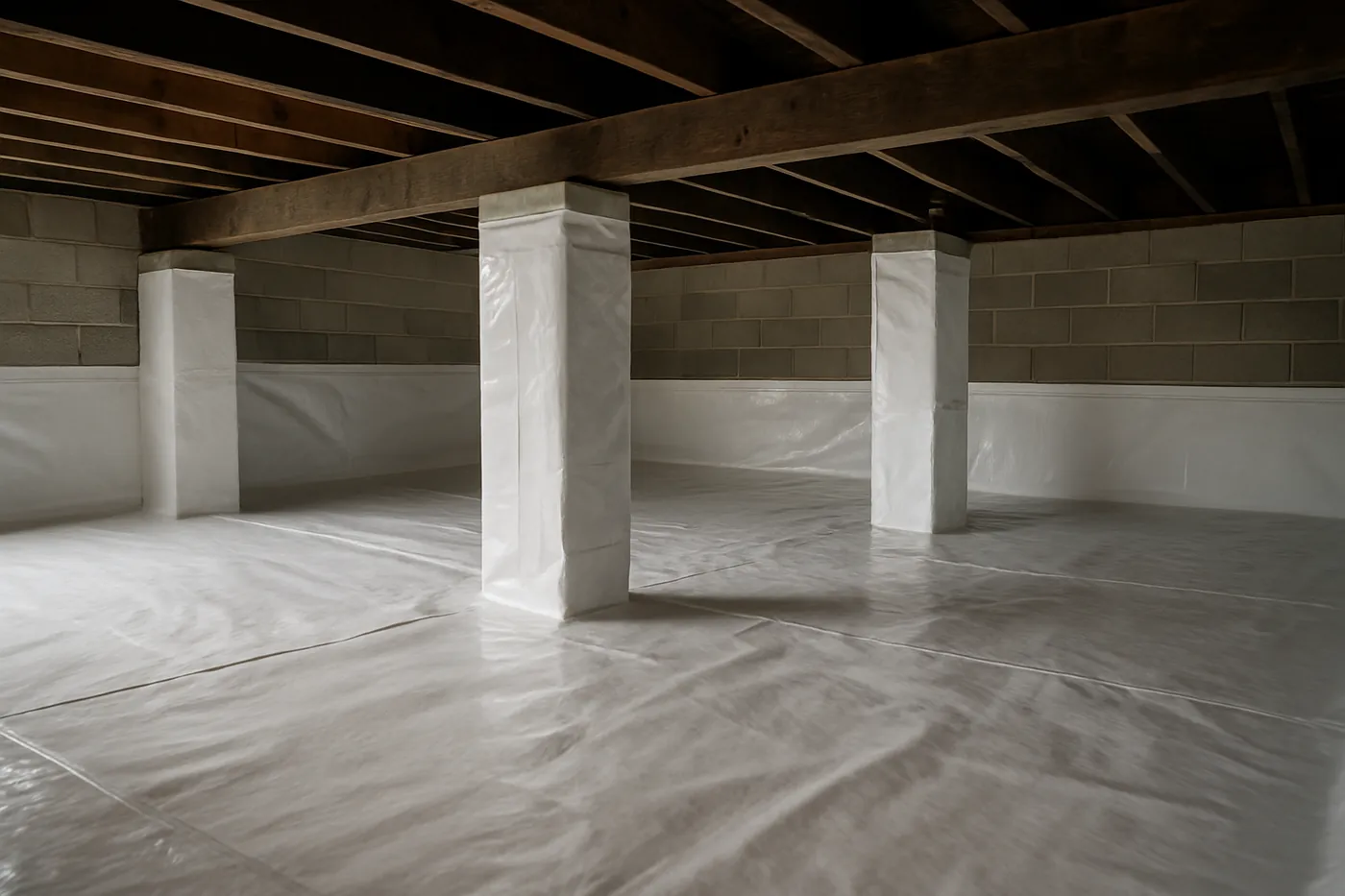
Vapor barrier installation in Huntsville costs $1,500–$4,000 for a reinforced 12–20 mil liner over the crawl space floor, sealed at seams and piers. It slows evaporation from bare soil, which is the largest single moisture source in an unsealed crawl — but not the only one.
What a ground liner does, what it does not, and how to tell which one your house needs.
The evaporation source, and the other one
Bare soil in a crawl space is not dry. It holds moisture and releases it upward as vapor continuously, and the volume is larger than most homeowners expect. A liner over that ground plane addresses it directly, and in a crawl that is otherwise sound, that alone can move humidity meaningfully.
The other source is the air itself. On a humid Alabama afternoon, outside air entering through open foundation vents carries a great deal of moisture into a space that is cooler than the air outside — and cooler surfaces are where that moisture condenses. A ground liner does nothing about this, which is the honest limit of the cheaper option.
Which one your house needs
| Condition | Liner alone | Full encapsulation |
|---|---|---|
| No water intrusion, ever | Reasonable option | Better result, higher cost |
| Water after storms | Not yet — route the water first | Not yet, same reason |
| Summer humidity above 65% in the crawl | Will help, may not be enough | The reliable answer |
| Wood moisture readings above 20% | Insufficient on its own | Appropriate, with structural review |
| Ducts or HVAC equipment in the crawl | Insufficient | Appropriate — conditioned equipment belongs in a conditioned space |
| Budget is the binding constraint | Real value, buys time | Phase it — liner now, seal later |
Installation details that decide the outcome
- Reinforced material, 12–20 mil — specified in writing, not described as “heavy duty”
- Seams overlapped and sealed — not merely laid alongside each other
- Cut and sealed around every pier — piers are where sloppy work shows first
- Debris and old material removed — a liner over construction debris punctures
- Termite inspection strip preserved where the liner meets the wall
- Enough material to be walkable so the next service visit does not destroy it
Phasing it honestly
A liner now and sealing later is a legitimate plan; ask for it written that way with prices for both stages. What does not work is buying a liner as a substitute for handling water that is actively entering the crawl — that is not a cheaper version of the right job, it is a lid. Where the inspection finds active water, a good specialist will say the liner is premature even though it is the smaller invoice. Both stages are priced in the cost guide.
Vapor barrier questions, straight answers
What does vapor barrier installation cost in Huntsville?
A reinforced liner installed over the crawl floor runs $1,500-$4,000 depending on square footage and how much old material and debris has to come out first. That price covers the ground plane. Running the liner up the walls, sealing vents, and adding a dehumidifier is encapsulation, and it is a different number.
Is a vapor barrier the same as encapsulation?
A vapor barrier isn't the same as encapsulation, and the difference is worth knowing before you buy either. A vapor barrier covers the ground to slow evaporation from the soil. Encapsulation seals the whole space - liner up the walls, vents closed, conditioned air or a dehumidifier - so the crawl becomes part of the building envelope. One is a component of the other.
Will a vapor barrier alone fix my humidity?
Sometimes, in a genuinely dry crawl with good clearance and no water intrusion. It reduces the largest single moisture source, which is evaporation from bare soil. What it cannot do is stop humid outside air entering through open vents on an Alabama summer day, and in this climate that source is substantial on its own.
What thickness should the liner be?
Reinforced material in the 12 to 20 mil range is the practical standard for a liner that will be walked on and worked around. Thin unreinforced sheeting is cheaper and tears during the first service visit, at which point it is decorative. Ask for the mil rating in writing, because it is one of the easiest specs to quietly downgrade.
Can I install a vapor barrier myself?
The material is not complicated and the work is honest labor, but the details decide the result: overlapping and taping seams properly, cutting and sealing around piers, and terminating at the wall while leaving a termite inspection strip. Get those wrong and you own an expensive ground cover rather than a vapor control layer.
Get a Huntsville crawl space inspection
Tell us what you’re noticing — floors that give underfoot, a room that never gets comfortable, humidity the AC cannot pull down, standing water after a storm — and we’ll pass your request to one independent local specialist serving Huntsville. They call you back to set up an inspection, which should include a moisture meter and a hygrometer.