Crawl space encapsulation in Huntsville costs $5,500–$15,000 for a complete sealed system. Within that: liner $1,500–$4,000, dehumidifier $1,200–$3,000, water management $2,500–$7,000, structural repair $1,500–$8,000.
What each range buys, the six specs that decide which quote is actually cheaper, and the order that keeps you from paying twice.
Every crawl space job, priced
| Work | Range | What is included |
|---|---|---|
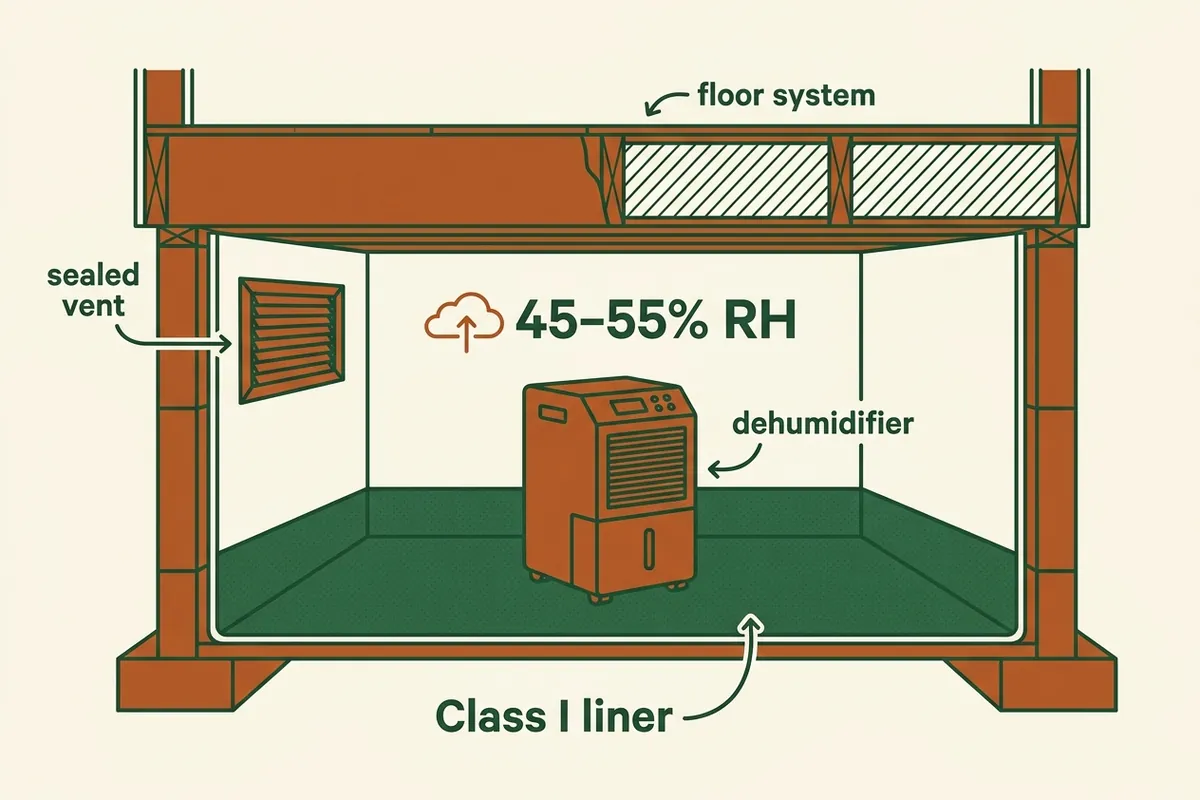
| Complete sealed system | $5,500–$15,000 | Liner up the walls, sealed vents and access, sized dehumidifier with condensate route |
| Vapor barrier only | $1,500–$4,000 | Reinforced 12–20 mil liner over the ground plane, sealed at seams and piers |
| Dehumidifier installed | $1,200–$3,000 | Crawl-rated unit sized to the space, plus condensate routing and electrical |
| Water management | $2,500–$7,000 | Interior drain tile and sealed sump, or exterior interception |
| Gravity daylight discharge | $1,500–$4,000 | Collection routed downhill by gravity — no pump, no power |
| Structural repair | $1,500–$8,000 | Sistering joists, girder sections, re-supporting piers, sill replacement |
| Sagging floor work | $1,500–$8,000 | Added supports, gradual elevation recovery, or stabilization at current height |
| Wall insulation | $1,500–$4,000 | Foundation wall and rim joist in a sealed crawl, plus failed batt removal |
| Exterior corrections | $150–$2,500 | Downspout extensions, regrading, swales — do these first regardless |
The six specs that decide which quote is cheaper
At least seven dedicated crawl space companies actively serve this metro. That is good for competition and hard on homeowners, because the quotes arrive looking similar and priced very differently. The gap is nearly always specification. Get these six in writing from every bidder and the comparison becomes possible.
- Liner thickness and reinforcement — a mil rating, not the word “heavy duty”
- Termination — fastened and sealed at piers and walls, with a termite inspection strip preserved
- Vents and access door — sealed and gasketed, or left as they are
- Dehumidifier capacity — pints per day, the square footage it was sized against, and where condensate discharges
- Water management — included, excluded, or assumed unnecessary, stated explicitly
- Warranty subject — does it cover the liner, or the humidity result?
That last one separates more bids than any other. A liner warranty promises the plastic will last. A performance warranty promises the space will hold a humidity level. Only one of those is a promise about whether the job worked.
What actually moves your number
- Square footage — the base driver for liner, insulation, and dehumidifier sizing
- Water — the largest single swing between two houses of the same size
- Clearance — under about eighteen inches, labor rises sharply and some scopes need a trench
- Structural findings — discovered under the house, not from the driveway
- Discharge distance — a long buried run to a proper exit point is real cost worth paying
- Debris and old material — tear-out and haul-away before anything new goes in
The order that keeps you from paying twice
Exterior water first, because it is cheapest and most often sufficient. Interior drainage next if water still enters. Structural repair after that, while the space is accessible. Liner and dehumidifier last, once the space is dry and has proven it through a storm.
Reverse that order and the failure mode is expensive and specific: a liner has to come up so somebody can reach the drainage or the framing beneath it, and you pay for the same liner twice. The sequence is the single most valuable thing on this page.
When the cheap answer is the right answer
More often than you would guess. A crawl space that is dry, has adequate clearance, and simply has bare soil evaporating into it may need nothing more than a liner and possibly a dehumidifier. That is a $3,000–$6,000 job, not a $12,000 one, and a good specialist would rather write it than talk you into the larger version. The readings decide, and you should get them either way.
Cost questions, straight answers
What is the average crawl space encapsulation cost in Huntsville?
A complete sealed system runs $5,500-$15,000. Within that, a reinforced vapor barrier is $1,500-$4,000, a sized dehumidifier $1,200-$3,000, water management $2,500-$7,000 where needed, and structural repair $1,500-$8,000. An average across those job classes would not describe anyone's house.
Why do two Huntsville quotes differ by thousands?
Almost always specification, and specification is almost never in the brochure. Liner thickness and whether it is fastened and sealed, dehumidifier capacity and where condensate goes, and whether drainage is included, excluded, or assumed unnecessary. Two quotes that answer those the same way can be compared on price.
Is the cheapest quote ever the right one?
Sometimes, and a good specialist will say so. On a genuinely dry crawl with good clearance, a liner and a dehumidifier is the whole job and a lower number is simply a fair price. Be careful when the low bid is low because drainage was left out of a crawl that takes water - that is not a discount, it is a different scope.
Does insurance cover any crawl space work?
Rarely for moisture and humidity, which policies treat as maintenance rather than sudden damage. Damage from a sudden accidental plumbing discharge is a different matter and is often covered, including the access work to reach the failure. Long-term seepage and gradual wood decay are typically excluded.
Can the work be phased?
The work can be phased, and there is a right order: exterior water first, then interior drainage if needed, then structural repair, then the liner and dehumidifier last. Phasing in that sequence means nothing gets redone. Phasing in reverse means paying to remove a liner so someone can fix what is under it.
Is there a charge for the inspection?
It depends on the company. Many local specialists don't charge for the inspection, including the visits where the whole recommendation is to lengthen two downspouts and look again after the next wet season. A good one includes going under the house, taking humidity, temperature, and wood moisture readings, measuring clearance, and walking the exterior water path. Ask for a written scope with a price on every line.
Get a Huntsville crawl space inspection
Tell us what you’re noticing — floors that give underfoot, a room that never gets comfortable, humidity the AC cannot pull down, standing water after a storm — and we’ll pass your request to one independent local specialist serving Huntsville. They call you back to set up an inspection, which should include a moisture meter and a hygrometer.